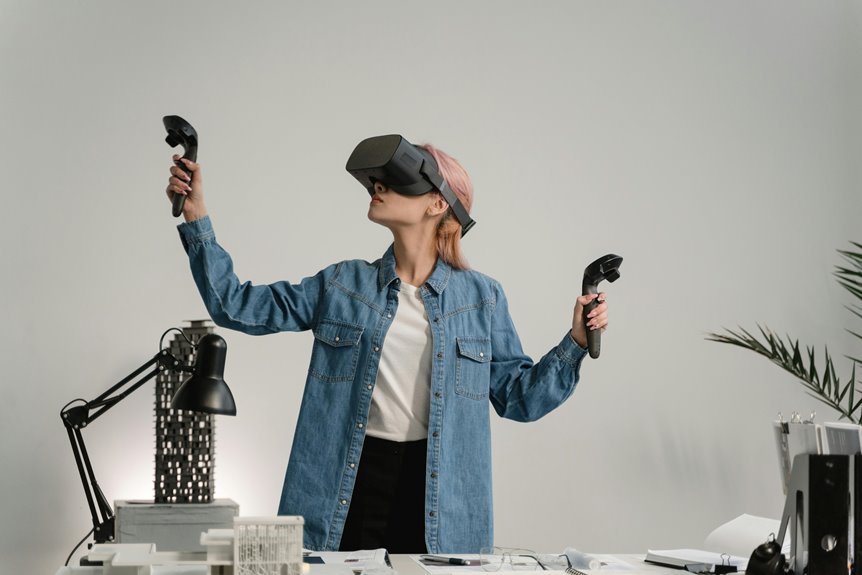
Measuring the ROI of VR and AR in the workplace isn’t just about numbers; it’s about understanding how these technologies impact your organization’s performance. You need to identify clear KPIs that align with your business goals and establish baseline metrics before implementation. But how do you guarantee you’re capturing the full picture? There are several factors to take into account, and it all starts with a strategic approach that can lead to meaningful insights.
Key Takeaways
- Establish baseline metrics to track employee productivity, training completion rates, and engagement before implementing VR/AR technologies.
- Calculate cost savings by comparing expenses related to traditional training methods versus VR/AR solutions for improved efficiency.
- Monitor training efficiency by evaluating time-to-competence and skill retention through assessments and participant feedback post-training.
- Assess collaboration improvements by measuring communication efficiency and problem-solving speed during immersive meetings using VR/AR tools.
- Conduct regular reviews of performance metrics and business outcomes to analyze the long-term impact of VR/AR implementations on overall ROI.
Understanding the Basics of VR and AR Technologies
As you explore the world of virtual reality (VR) and augmented reality (AR), it’s essential to grasp their fundamental differences and applications.
VR immerses you in a fully digital environment, blocking out the real world, while AR overlays digital information onto your physical surroundings. This distinction shapes how each technology can be used in the workplace.
For instance, VR can simulate training scenarios, allowing for hands-on practice without real-world risks. Conversely, AR can enhance collaboration by providing real-time data and visualizations during meetings or presentations.
Understanding these basics helps you identify which technology suits your business needs, whether you’re looking to improve training, enhance productivity, or create innovative customer experiences.
Knowing the right tool can greatly impact your ROI.
Identifying Key Performance Indicators (KPIs)
To effectively measure the ROI of VR/AR technologies, you need to identify the right key performance indicators (KPIs).
Start by defining metrics that truly reflect your business goals and objectives.
This alignment guarantees you’re tracking progress that matters to your organization.
Defining Relevant Metrics
When measuring the ROI of VR/AR in the workplace, defining relevant metrics is essential for understanding their impact. Start by identifying key performance indicators (KPIs) that align with your specific objectives.
For instance, you might track employee engagement, productivity improvements, or training completion rates. Focus on quantitative metrics, such as reduction in training time or increased sales, and qualitative metrics, like employee satisfaction or retention.
Consider how VR/AR technology enhances collaboration and innovation, and measure these effects through feedback surveys or project outcomes.
Aligning With Business Goals
Aligning VR/AR initiatives with your business goals is essential for maximizing their impact and guaranteeing a positive ROI. Start by identifying key performance indicators (KPIs) that reflect your organization’s objectives.
Ask yourself: What specific outcomes do you want to achieve with VR/AR? Whether it’s improving training efficiency, enhancing customer engagement, or boosting sales, your KPIs should clearly reflect these targets.
Next, make sure that your VR/AR projects are designed to meet these benchmarks. Regularly assess your progress against the KPIs to gauge effectiveness.
This alignment not only helps you measure ROI but also keeps your VR/AR efforts focused and relevant. By doing this, you’ll demonstrate how VR/AR contributes to your overall business success, justifying further investment in these technologies.
Establishing Baseline Metrics Before Implementation
Establishing baseline metrics is essential for measuring the success of VR and AR implementations in the workplace. Before you immerse yourself in these technologies, assess your current performance levels across key areas related to your goals.
Identify metrics like employee productivity, training completion rates, and error rates to create a clear picture of where you stand. By collecting this data, you’ll have a solid foundation to compare against after implementing VR and AR solutions.
Don’t forget to engage stakeholders in this process; their insights can help pinpoint metrics that matter most to your organization. This preparation will guarantee you can effectively measure the impact of your initiatives and drive continuous improvement in your workplace.
Calculating Cost Savings From VR and AR Adoption
When you adopt VR and AR technologies, you can greatly boost training efficiency, leading to faster skill acquisition.
You’ll also notice reduced equipment expenses as these tools can streamline processes and minimize material waste.
Finally, analyzing time savings can reveal just how much more productive your team becomes with these innovative solutions.
Training Efficiency Improvements
By integrating VR and AR technologies into training programs, companies can considerably enhance efficiency and reduce costs.
These immersive tools allow employees to learn in a simulated environment, leading to faster skill acquisition and better retention.
Here’s how VR and AR can streamline your training efforts:
- Engagement: Interactive experiences keep learners focused and motivated, resulting in higher participation rates.
- Consistency: VR and AR guarantee that every employee receives the same high-quality training, minimizing discrepancies and errors.
- Flexibility: Employees can train at their own pace and on their schedules, reducing downtime and improving overall productivity.
Reduced Equipment Expenses
As companies increasingly adopt VR and AR technologies, they often discover significant savings on equipment costs. By using virtual simulations instead of physical prototypes, you can drastically reduce expenses related to materials, manufacturing, and maintenance.
For instance, instead of purchasing and storing bulky equipment, you can create realistic 3D models that employees can interact with. This not only cuts down on space but also minimizes the need for costly repairs and replacements.
Furthermore, VR and AR can facilitate remote collaboration, meaning you won’t have to invest in travel or shipping of equipment. Ultimately, these technologies allow you to optimize your budget, channeling savings into other critical areas of your business while enhancing operational efficiency.
Time Savings Analysis
With reduced equipment expenses setting the stage for enhanced efficiency, time savings become another critical metric in evaluating the ROI of VR and AR technologies.
You can quantify time savings by analyzing how these tools streamline processes and reduce downtime. Consider the following factors:
- Training Efficiency: VR and AR can shorten training times by offering immersive, hands-on experiences without the need for lengthy sessions.
- Fewer Mistakes: Enhanced visualization and simulations lead to fewer errors, saving time spent on corrections and rework.
- Faster Prototyping: Rapid prototyping with AR can accelerate product development cycles, allowing for quicker market entry.
Evaluating Training Efficiency and Effectiveness
When you incorporate VR/AR technologies into training programs, evaluating their efficiency and effectiveness becomes essential for maximizing your investment.
Begin by setting clear objectives for what you want to achieve with the training. Track metrics such as completion rates, time taken to master skills, and the application of learned skills in real-world scenarios.
Conduct assessments before and after training to measure knowledge retention and practical application. Also, gather feedback from participants to identify areas for improvement.
Analyzing these factors will help you determine if the VR/AR training meets your goals and enhances overall productivity. Use this data to refine your programs, ensuring they deliver the best possible results and justify the costs associated with implementing VR/AR technologies.
Measuring Employee Engagement and Satisfaction
Evaluating training efficiency and effectiveness is only one part of the equation; understanding how VR/AR technologies impact employee engagement and satisfaction is equally important.
Engaged employees are more productive, and satisfaction directly influences retention rates. To gauge the impact of VR/AR, consider these key areas:
- Feedback collection: Regularly survey employees about their VR/AR experiences and how they feel about training.
- Observation: Monitor interactions during VR/AR sessions to assess enthusiasm and participation levels.
- Performance metrics: Compare engagement levels before and after implementing VR/AR technologies to measure changes.
Analyzing Time-to-Competence for New Skills
As organizations adopt VR/AR technologies for training, analyzing time-to-competence for new skills becomes essential.
You need to track how quickly employees master these new skills compared to traditional training methods. Start by establishing a baseline for current training time and effectiveness.
Implement VR/AR solutions and monitor learning progress through metrics like completion time, assessment scores, and retention rates.
Monitor the effectiveness of VR/AR training by tracking completion time, assessment scores, and retention rates.
Collect feedback from learners to understand their experiences and challenges. This data will help you identify the strengths of your VR/AR programs and areas for improvement.
Assessing Collaboration Improvements in Remote Teams
Although remote work offers flexibility, it can also create challenges for team collaboration.
Evaluating how VR/AR improves collaboration among remote teams is essential for understanding its impact. Here are a few key areas to analyze:
- Communication Efficiency: Measure how VR/AR tools enhance real-time discussions and reduce misunderstandings.
- Engagement Levels: Look at how immersive experiences boost participation and motivation during meetings.
- Problem-Solving Speed: Track the time taken to resolve issues collaboratively using VR/AR compared to traditional methods.
Gathering Qualitative Feedback From Users
How can you truly understand the impact of VR/AR tools in the workplace? Gathering qualitative feedback from users is essential.
Start by encouraging open discussions where team members can share their experiences with the technology. Ask targeted questions about usability, engagement, and overall satisfaction. This will help you identify strengths and weaknesses in the implementation of VR/AR tools.
Encourage open discussions to gather user experiences and insights on VR/AR tool usability and engagement.
Consider creating surveys or conducting one-on-one interviews to dive deeper into their thoughts. Listen to their suggestions for improvements, as this feedback can guide future developments.
Collecting anecdotes and specific examples can also highlight the real-world benefits and challenges users face. By valuing user input, you’ll gain insights that quantitative data alone can’t provide, ensuring your VR/AR initiatives are truly effective.
Conducting Long-term Impact Assessments and Reviews
To truly gauge the effectiveness of VR/AR tools in the workplace, you need to conduct long-term impact assessments and reviews. This process helps you understand how these technologies influence productivity, employee engagement, and overall business outcomes over time.
Consider focusing on the following key areas during your assessments:
- Employee Performance: Measure changes in efficiency and productivity levels after implementing VR/AR solutions.
- Skill Retention: Evaluate how well employees retain skills learned through immersive training experiences.
- Cost Savings: Analyze any reductions in training costs or error rates linked to VR/AR applications.
Frequently Asked Questions
What Industries Benefit Most From VR and AR Technologies?
You’ll find industries like healthcare, education, and manufacturing benefiting most from VR and AR technologies. These sectors leverage immersive experiences to enhance training, improve patient care, and streamline processes, ultimately boosting productivity and innovation.
How Can Small Businesses Afford VR and AR Solutions?
You can afford VR and AR solutions by exploring grants, partnering with tech companies, or starting with low-cost platforms. Prioritize your needs, test affordable options, and gradually invest as you see positive impacts on your business.
What ARe Common Challenges in Implementing VR and AR?
You’ll face challenges like high costs, limited technical expertise, and resistance to change from employees. Additionally, ensuring content quality and compatibility with existing systems can complicate implementation, making it essential to strategize effectively from the start.
How Do I Choose the Right Vr/Ar Tools for My Team?
To choose the right VR/AR tools for your team, assess your specific needs, budget, and technical capabilities. Research user reviews, request demos, and guarantee compatibility with existing systems to maximize effectiveness and user engagement.
What Future Trends Should We Expect in VR and AR Workplace Applications?
You can expect increased integration of AI, enhanced collaboration tools, and more immersive training experiences in VR and AR applications. These trends will revolutionize how teams interact, learn, and solve problems in the workplace.